
Welcome to my blog!
If this is your first time here, I hope you find some useful information and thanks for stopping.
In this article I’m going to share how I turn any watercolor paper pad into a watercolor block.
I’ve been using watercolor pads since I started using watercolors and I’m not a big fan of the border left by tape and, though easy to fix, I’d rather avoid warped paper. Now there are so pros and cons to each. Watercolor pads may warp but, for artist like me who like to have multiple paintings going at once, it’s nice to be able to start a painting, rip off a sheet and begin a new one and so on. Keep things flowing! Watercolor blocks do not offer this but like I said they do prevent the paper from warping. When I looked around though, most watercolor blocks that I could find we’re far more expensive than watercolor pads so I came up with a way to make my own.
Here’s what you will need:
- Any watercolor pad of your choice. I use Canson mostly but your favorite will work as long as the sides are flush.
- Clamps. I use these here. They work just fine for me. You can also include a thick metal strip between the paper and the clamps for added support. Something easily found at any home improvement store.
- Flat paint brush (nothing fancy).
- Book Compound. I use this brand but any brand will do I’m sure. It’s very easy to apply, dries clear and cleans right off my brush with water as long as it hasn’t dried. I haven’t let that happen so i don’t know the outcome.
- Cup of water for cleaning off your brush between coats.
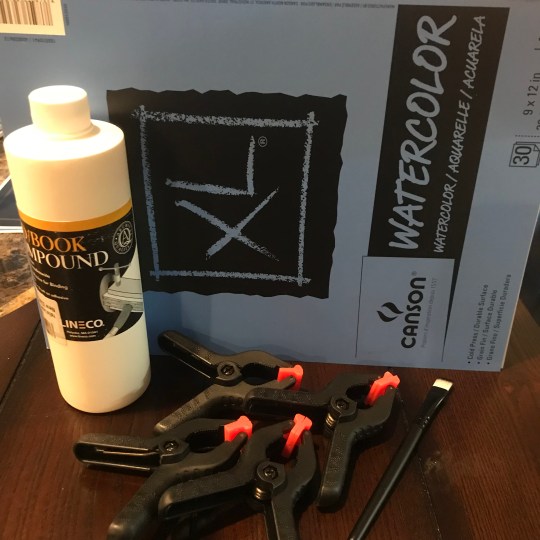
Now that you have gathered your supplies you can make your own watercolor block. The process is simple and worth it.
Take the clamps and put them on one side of your paper pad right below the edge and make sure then are all flush to prevent compound leaking in between the pages. If you want to use a metal strip it goes in between the clamps and the paper. I start with one of the sides adjacent to the existing bond that came with the pad. I put the clamps about 2-3 inches apart with one on the corner.

Next dip your paint brush in the compound and apply a thin layer to the side of the pad.
Let this dry for about a minute and apply a second layer. I tried about 5 layers and found it to be too much. The paper didn’t tear off as easily as it should. 2-3 layers works the best. This stuff dries very quickly so be sure to place your brush in the cup of water when not in use.
Also be sure to check the sides of the paper after each layer and make sure no compound has dripped down as this will make the paper rip when you try to tears off a sheet.
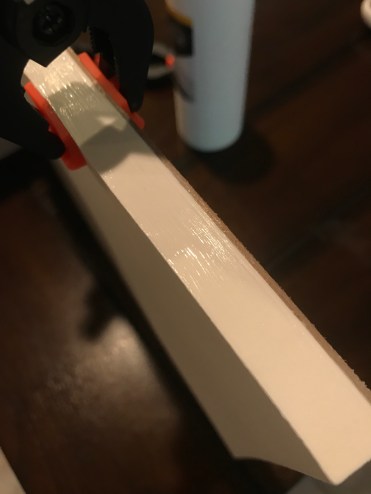
Once you are done adding your layers it should look like this.
Now repeat on the remaining two sides. I leave a corner loose so I can insert a palette knife to remove a sheet a paper. About an inch on each side of the corner works well.
Once all side are done I leave a clamp or two on while it fully dries for about 24 hours.
After 24 hours I remove the clamps and this is the finished product!


I have done this to several of my watercolor pads and have been pleased every time and what’s so great about this is that it can be applied to any watercolor pad you want. Any size, any brand. I now have a bunch in my studio so I can once again work on multiple paintings at once like a maniac.
I hope you find this helpful. Don’t hesitate to contact me if you have any questions and please let me know what you think in the comments.
 Crafted By NEO